Q.
A friend asked me what are the differences between appraisal used in business venture, stock market and property investment. How are they different from each other? Can you use the same measurement to evaluate investment in property?
A.
On the first look, everything is possible. You can even compare a man to a woman, correct? Although they are largely different in physical and mental attributes.
First of all, comparing biz venture, share performance and property is like comparing apples, oranges and grapes. They are all different things.
Although you could ask how sweet is an apple, an orange or a grape when compared, the outcome of the comparison may not be meaningful. This is because grapes are meant to be sweet although it is still a citrus, oranges are acidic in nature.
Similarly, a bungalow house is not a condo or double storey terrace. Although the measurement of size may be a key comparison, it is not the most important comparison. The point is people who stays in condo probably does not mind the reduced size; for they see space as burden to their living.
In the context of comparing fruits above, some people prefer oranges more, not because of anything about taste but because they like yellow?
This characteristic of different variables, is compounded with even more complicated bases of comparisons like the tangible and intangible values of the property, as compared to business and financial instruments.
To simplify the matter, I would give some examples to distinguish property from stock and business venture.
1. Property is both tangible and intangible.
Property in the eye of investors can be briefly broken into two parts. First is the physical size and build, etc (capacity and utility) and second is the location, and the space it occupies, which is irreplaceable.
The tangible portion - the size and usability of the the space. The intangible portion - its mere location and strategic look. You cannot have a business or stock which has this type of combinations. So, how then can you compare them?
2. Property investment is both active and passive.
Property as in land, is almost idle. However, if you have a commercial building, it is usually actively tenanted, or partly utilized. A stock or a business, if is viable as an investment, inevitably has to be actively traded. A viable business would require continuity as a going concern in generation of return. Or else, it is a liability.
3. There is residual value in property. It is used as a leverage. Further reading here.
Property has an indefeasible title, be it land, bungalow, strata unit or even a parking bay. This has a value, even when the property is damaged or destroyed. Worst case scenario - when it is under Land Acquisition Act, 1960 it is still compensated with a 'market value'. Stock or business venture do not necessarily have this kind of advantage.
With the above characteristics of property, you can see that property is beyond that of the stock and business venture. That is why business and stock could build on property as asset. But property would not likely be a prerequisite to own stock or business. What this means is you do not own a property to get the right to own a stock. You try to buy a share in a company which owns a whole lot of property (REIT). It would be unfair to use the yardstick of financial appraisal to evaluate property.
In general business appraisal, you would take the return on investment (ROI) to determine if this is a good business venture. So, for a business that employ workers and pays salaries, the return would mean to deduct the expenses of the workers to arrive at an operating income. This can be a comparison between businesses. If say a fast moving consumable market, manufacturing cost (labour) can be a big portion of the cost. So, taking it at 50% of the total expenditure, you can quite accurately say the business is making a profit after deducting cost of labour.
For Stock, ROE is usually the yardstick - return on equity. The stock borrowed money from investors. The return - in dividend declared, usually is a measurement of the return on equity, where the stock gives back to the investor. So, a big expenditure of the stock - likely again - labour cost, would be taken out from the total income generated in that company to arrive at profit. This profit then pays dividend to the stock investors.
In the case of property, labour cost is never a big expenditure. The running cost of the house tenanted is probably less than 10% of the income on rental. This consists of mainly maintenance fee, sinking fund, annual rates paid to local councils and insurance cost. So, the investment outcome rely very much on the intangible factors - like location and accessibility of the property. Such portion consists of namely:
1. Ease of access - like LRT, Road.
2. Entertainment outlets nearby.
3. Security, theft and sense of peace.
4. Lifestyle, e.g. condo and apartments - community living.
5. Type of title - as category 'building' is of higher value than 'agriculture'.
*Title is probably the single most interesting part of 'value' to property that other investment types cannot offer. There is no similar distinct characteristic to a property like that of 'title' to land. Preference share, for example would defer from ordinary share so to illustrate this significance. However, such distinction cannot be translated to the magnitude of the difference in land title.
Preference share for the example above, would have its limitation from sharing the profit of the company. On the other hand, title is able to open up entirely the potential of the land.
Therefore, the driving factors to an investment outcome of a property is very much NOT in the control of costs or efficiency of the operation. It is more on the intangible factors. These factors contribute probably more than 80% of the reasons that property could do well, rather than the reduction of cost or efficiency of running the business.
Take for example, a commercial property tenanted as a food court. The rental of the property would not double unless there is a high traffic flow of people coming to patronize this food court. There is some elements of comfort in eating there - for example air-conditioning. However, there is no direct effect of more people commuting to this food court just because of air-conditioning. Hence, increasing workers and putting air-conditioning might have no major impact in increasing rental of the food court.
For the business of the food court, it is definitely so. Because when a food court is well managed, there is an increase of volume of food sold, hence increase in return on investment (due to more worker and air-conditioning).
The investment on the property - commercial food court, would only be making more return when there is higher rental. That higher rental can only be realized when there are favourable elements like:
1. More parking bays, or a shopping mall next door.
2. More accessibility - by public transport.
3. Better security - may be interpreted as patrons feel save when eating there.
4. Food court be turned into Restaurant, being a different class of lifestyle.
And, yet the determining factor of the investment in this commercial property would very much be its location (accessibility) which cannot be replaced by another critical substitute.
You cannot substitute a space with another space. It is irreplaceable.
You can substitute a business by another business, for example a business of selling washing machine to households to selling washing machine to laundrette operator. Or, selling handphone online from giving to supermarket display.
You can substitute a stock by another stock. You can buy one blue chip, and later sell it to buy another blue chip. You can even sell all your blue chips and put all your monies into emerging stocks, and make the same money (or more) provided that you are clever for such trade.
BUT, you cannot substitute a space with another space. It is that characteristic of property that more than 80% of its value is intrinsic of its own. Its return on investment cannot be compared with stock market or business venture on the same yardstick. It is not comparing the like to like.
I rest my case.
Showing posts with label Comparative Index. Show all posts
Showing posts with label Comparative Index. Show all posts
Friday, April 21, 2017

Monday, December 26, 2016
Multiple Listing Service (MLS) and Index
Q.
How to come out with an Inter-Property Index?
A.
To collect information of all the property transacted over time requires a system of recording the information - data collection point.
This set of data would be stored in a system called 'Multiple Listing Service' - MLS. When a certain function is selected, the data will be calculated to give a general price value of the property similar to the type recently sold.
Take for example a premium condo with size of 1,000 sqf, 2 parking bays and fully furnished would be likely be RM600,000 in Kuching, around 2016-2017. Similar type of property in KK would be an addition of 20% premium, so likely be RM720,000, and KL RM840,000 (40% premium).
See posting at My-RealProperty2 on this subject of MLS.
Ref:
Own account.
How to come out with an Inter-Property Index?
A.
To collect information of all the property transacted over time requires a system of recording the information - data collection point.
This set of data would be stored in a system called 'Multiple Listing Service' - MLS. When a certain function is selected, the data will be calculated to give a general price value of the property similar to the type recently sold.
Take for example a premium condo with size of 1,000 sqf, 2 parking bays and fully furnished would be likely be RM600,000 in Kuching, around 2016-2017. Similar type of property in KK would be an addition of 20% premium, so likely be RM720,000, and KL RM840,000 (40% premium).
See posting at My-RealProperty2 on this subject of MLS.
Ref:
Own account.
Saturday, March 26, 2016
Dynamics of Time and Property
Q.
I have been following this project! The developer is not putting in promo into getting big brands to come to this commercial centre! So, I am not going to buy any property here, it is such a sloppy project! What do you think?
A.
About the time of Chinese New Year, someone close to me came to view my new place, and commented on the project nearby.
Notably, he was right! There has been minimum effort shown by the developer to promote this place. The developer is however, left only with some units unsold in this project anyway. In this article, I try to analyse the whole scenario with the recent knowledge learned from a friend who is running shopping mall in Kota Kinabalu.
Okie, the whole story should date back to 1997. Around that time, the developer launched a mega project - a new township in a fringe of Kuching City. This mega project eventually took many years to complete. In fact, at the time of writing, there are many phases of the master plan yet to be completed.
What is strong about this developer is that it is a conglomerate from West Malaysia, and is very much a long term player in the field of property development. It however, had a different strategy with this project in Kuching.
Why do I say so?
Most developers are players with cash flow in mind. So, they would choose to build residential housing (smaller units) which are basic needs of the population at large. This will take some time to complete. Hence, the element of time - the title of this article is at play. They will wait for the time the concentration of population has matured, so as to launch the commercial property at a higher price for profit taking. This is the game that the element of time is to their advantage!
Therefore, it would not be a surprise that the prime spot of land in the whole master plan is drawn with the end in mind. The steps would be first building the smaller units of residential houses, then, the higher end Semi-D, or Terrace houses. Subsequently, the bigger units of bungalows and then the Shoplots and Shopping malls.
The strategy is to leave the best location for the most profitable launch at the end. What we say in choosing durian - let the best durian belongs to the highest bidder!
Then, there is the element of time! The whole evolution of the best piece of jewel would only be realized with passage of time! And, it will surely take longer time to mature if only the residential sector be completed first before the commercial sector. So, instead of a step-wise manner, the project did a concurrent launch approach to save time.
They launched the commercial shops similar with the residential sector, without giving time for the completion of the residential housing. Probably because they have cheap land bank and were resource ready - using the concept that it was similar per unit cost to build shoplots as residential houses*, they went side-by-side.
In this manner, the shops were able to sell at much lower price compared to similar shops in the vicinity of Kuching - as low as RM250,000 for a ground floor strate unit of around 1,000 square feet!
This strategy got the shops quickly sold! The cash flow was healthy as the materials need to build the 3 walls and a ceiling was probably very little then (20 years ago). Be reminded - this is a mere 3 walls and a ceiling, nothing more! The 1st, 2nd and 3rd floor units were also sold below market price. So, the entire project of more than few hundred units were sold in a short time.
In fact, I know of some taxi driver whose father without looking at the site, bought 2 units of ground floor shops in a blink of an eye!
Years later, I was told his two shops were not even rented out! Why? Because too many shops were built at the same time, and there was no economic activities around that area - the crowd has not move in yet! Population - urbanization in Kuching is much slower compared to townships in West Malaysia! The developer probably learned this the long hard way!
The same project in West Malaysia might have an uptake 10 times faster than in Kuching! Population size and exodus of people to city for employment were significantly more acute in West Malaysia than Kuching.
To come back to the issue of the question. This developer builds and sells, NOT manages property like mall or office buildings. Developers are seldom Property Managers. In fact, you need to be a registered Valuer to be a Property Manager! Most developers are businessman-politician, they are seldom professionals. Professionals make money too slow!
So, most developers' core business is not a shopping mall operator. Thus, it is not its prime objective to run the shops to woo crowd in for any brands.
But to the investor, it is 100% his prime objective to rent or sell his property in the future! Inevitably, he seeks developers who can deliver such promises. Yet, the mis-match is this mentality in Kuching.
People looks for property which is good and cheap! Is there such property?
May be you are just lucky! In real life, if you are 10 years in real estate business probably you will know some desperate sellers by coincidence. Or else, it is probably once in a life time occasion! And, it might not be that good price after all. Indeed, you may have learned the truth later on!
The developer who is build-to-sell does not have objective in securing the best tenant, but may offer the best value-buy for its property. After all, they have to get rid of the stock!
The developer who is build-to-rent would look after its own profit by securing the best tenant but sell the property at an inflated price with the promises tied-in. Of course, if the developer promises you to bring in best tenants and yet selling off 90% of the property - you know it is a scam!
Why?
Because keeping tenant is never his priority, and hence it is a blank promise! Ask yourself, would you pay attention to after-sale service if you don't actually use the product? You only do so if you are the quality assurance or research guy. Even that, it might be just lip service to public.
In fact, you might not be interested in making good the product! You just replace it with a new one!
Due to market competition and demand by investors, this service becomes too important a sales pitch.
Therefore, current property developers have to incorporate such tactics - lease back and manage in getting big brands for your investment! Or else, nobody is going to buy the shop lots!
But then, the predicament is that the older shops were sold at much lower price compared to the recent launches. These older retail space competes with the new ones! The potential tenant is worried that going to the new shops would be too expensive to operate (for the same biz - e.g. food outlet) compared to the old shops. Thus, would prefer a cheaper rental than the higher rental of the new shops.
On the other hand, the newer shops cannot offer the lower rental competing with the old shops due to higher cost of building material, labour and maintenance. So, it has become victim of time and money as investment return can drag on for year!
Hence, it is timing which commands respect. However, how you see the future is very much a perspective of individual choice. I try to be more positive at this development so, I chose to invest! But, I may be wrong!
Well, no risk no gain!
* Assumption is mine. In actual fact, it costs less to build an empty shop lot than a full size semi-D house.
Reflection
The best deal syndrome - is never ending issue in property investment. Everyone looks for the cheapest and hottest property and expect it to be served in a sliver platter.
This is expectation gap that slows you down rather than speeds you up.
The timing issue is a bigger picture, not a today, next week thing. It may be a limiting factor - as stock depletes over time and things get appreciated or depreciated over the long term. Property usually has an advantage with passage of time. But, good advice might not!
So, what is the dynamics of time in property?
The straight forward answer is whether it is economically suitable time to invest? Rather than what property to invest. Because what property to invest very much depends on your risk appetite and your pocket size.
Lastly, no action talk only - NATO is waste of time!
As simple as that!
I have been following this project! The developer is not putting in promo into getting big brands to come to this commercial centre! So, I am not going to buy any property here, it is such a sloppy project! What do you think?
A.
About the time of Chinese New Year, someone close to me came to view my new place, and commented on the project nearby.
Notably, he was right! There has been minimum effort shown by the developer to promote this place. The developer is however, left only with some units unsold in this project anyway. In this article, I try to analyse the whole scenario with the recent knowledge learned from a friend who is running shopping mall in Kota Kinabalu.
Okie, the whole story should date back to 1997. Around that time, the developer launched a mega project - a new township in a fringe of Kuching City. This mega project eventually took many years to complete. In fact, at the time of writing, there are many phases of the master plan yet to be completed.
What is strong about this developer is that it is a conglomerate from West Malaysia, and is very much a long term player in the field of property development. It however, had a different strategy with this project in Kuching.
Why do I say so?
Most developers are players with cash flow in mind. So, they would choose to build residential housing (smaller units) which are basic needs of the population at large. This will take some time to complete. Hence, the element of time - the title of this article is at play. They will wait for the time the concentration of population has matured, so as to launch the commercial property at a higher price for profit taking. This is the game that the element of time is to their advantage!
Therefore, it would not be a surprise that the prime spot of land in the whole master plan is drawn with the end in mind. The steps would be first building the smaller units of residential houses, then, the higher end Semi-D, or Terrace houses. Subsequently, the bigger units of bungalows and then the Shoplots and Shopping malls.
The strategy is to leave the best location for the most profitable launch at the end. What we say in choosing durian - let the best durian belongs to the highest bidder!
Then, there is the element of time! The whole evolution of the best piece of jewel would only be realized with passage of time! And, it will surely take longer time to mature if only the residential sector be completed first before the commercial sector. So, instead of a step-wise manner, the project did a concurrent launch approach to save time.
They launched the commercial shops similar with the residential sector, without giving time for the completion of the residential housing. Probably because they have cheap land bank and were resource ready - using the concept that it was similar per unit cost to build shoplots as residential houses*, they went side-by-side.
In this manner, the shops were able to sell at much lower price compared to similar shops in the vicinity of Kuching - as low as RM250,000 for a ground floor strate unit of around 1,000 square feet!
This strategy got the shops quickly sold! The cash flow was healthy as the materials need to build the 3 walls and a ceiling was probably very little then (20 years ago). Be reminded - this is a mere 3 walls and a ceiling, nothing more! The 1st, 2nd and 3rd floor units were also sold below market price. So, the entire project of more than few hundred units were sold in a short time.
In fact, I know of some taxi driver whose father without looking at the site, bought 2 units of ground floor shops in a blink of an eye!
Years later, I was told his two shops were not even rented out! Why? Because too many shops were built at the same time, and there was no economic activities around that area - the crowd has not move in yet! Population - urbanization in Kuching is much slower compared to townships in West Malaysia! The developer probably learned this the long hard way!
The same project in West Malaysia might have an uptake 10 times faster than in Kuching! Population size and exodus of people to city for employment were significantly more acute in West Malaysia than Kuching.
To come back to the issue of the question. This developer builds and sells, NOT manages property like mall or office buildings. Developers are seldom Property Managers. In fact, you need to be a registered Valuer to be a Property Manager! Most developers are businessman-politician, they are seldom professionals. Professionals make money too slow!
So, most developers' core business is not a shopping mall operator. Thus, it is not its prime objective to run the shops to woo crowd in for any brands.
But to the investor, it is 100% his prime objective to rent or sell his property in the future! Inevitably, he seeks developers who can deliver such promises. Yet, the mis-match is this mentality in Kuching.
People looks for property which is good and cheap! Is there such property?
May be you are just lucky! In real life, if you are 10 years in real estate business probably you will know some desperate sellers by coincidence. Or else, it is probably once in a life time occasion! And, it might not be that good price after all. Indeed, you may have learned the truth later on!
The developer who is build-to-sell does not have objective in securing the best tenant, but may offer the best value-buy for its property. After all, they have to get rid of the stock!
The developer who is build-to-rent would look after its own profit by securing the best tenant but sell the property at an inflated price with the promises tied-in. Of course, if the developer promises you to bring in best tenants and yet selling off 90% of the property - you know it is a scam!
Why?
Because keeping tenant is never his priority, and hence it is a blank promise! Ask yourself, would you pay attention to after-sale service if you don't actually use the product? You only do so if you are the quality assurance or research guy. Even that, it might be just lip service to public.
In fact, you might not be interested in making good the product! You just replace it with a new one!
Due to market competition and demand by investors, this service becomes too important a sales pitch.
Therefore, current property developers have to incorporate such tactics - lease back and manage in getting big brands for your investment! Or else, nobody is going to buy the shop lots!
But then, the predicament is that the older shops were sold at much lower price compared to the recent launches. These older retail space competes with the new ones! The potential tenant is worried that going to the new shops would be too expensive to operate (for the same biz - e.g. food outlet) compared to the old shops. Thus, would prefer a cheaper rental than the higher rental of the new shops.
On the other hand, the newer shops cannot offer the lower rental competing with the old shops due to higher cost of building material, labour and maintenance. So, it has become victim of time and money as investment return can drag on for year!
Hence, it is timing which commands respect. However, how you see the future is very much a perspective of individual choice. I try to be more positive at this development so, I chose to invest! But, I may be wrong!
Well, no risk no gain!
* Assumption is mine. In actual fact, it costs less to build an empty shop lot than a full size semi-D house.
Reflection
The best deal syndrome - is never ending issue in property investment. Everyone looks for the cheapest and hottest property and expect it to be served in a sliver platter.
This is expectation gap that slows you down rather than speeds you up.
The timing issue is a bigger picture, not a today, next week thing. It may be a limiting factor - as stock depletes over time and things get appreciated or depreciated over the long term. Property usually has an advantage with passage of time. But, good advice might not!
So, what is the dynamics of time in property?
The straight forward answer is whether it is economically suitable time to invest? Rather than what property to invest. Because what property to invest very much depends on your risk appetite and your pocket size.
Lastly, no action talk only - NATO is waste of time!
As simple as that!
Sunday, September 27, 2015
Rental Return as a Bait?
Q.
Can you rely on the Return of Rental Income to purchase your property?
A.
Recently in SHEDA Property Expo - 25 - 28 Sep, 2015, Kuching, I came to notice that most property sellers from KL are making Return of Rental Income as a selling point for their products.
One project in the Greater KL area even forecast the return of rental based on the hostel charges by a nearby university to come out with an astonishing figure of RM6,000 per month! This is compared to the selling price of RM1mio, a whopping 7.2% yearly rental income return!
Yes, you might get such return if your property was bought say >10 years ago! An example is my Pandan Indah Condo - RM1,400 rental monthly, purchase price was RM180k.
Hold your horses! If you are looking for a return of rental at >6% (Amanah Saham Malaysia or KWSP), then a property costing RM400k should be rented at RM400k x 6% / 12 = RM2,000!
RM800k property would require a rental of RM4,000! And, RM1.2mio at RM6,000!
So, this unit of apartment next to a Uni is asking for at least RM5,000 rental to achieve a 6% return. Let's look at the specifics.
A little over a thousand square feet, the unit has 3 rooms. And, if each room is rented at RM1,000, it is impossible to come out with RM6,000 monthly rental collection! So, I was pondering over how they came out with such figures!
According to the negotiator, the rental per month per head for the hostel in this university is RM900-1,000 per person! So, let say we put 2 persons sharing a room, that is RM6,000!
OIC!
This is how they came out with the figure! So, I did not want to ask further but threw him a question:
If I were to use the RM1mio to buy a few units of lower price property, would I get a better outcome?
He asked his boss to answer me.
The boss initially thought that I was saying buying a few units of RM1mio as an investment! Wow, is that how easy to sell property in KL?
After having clarified, he asked me back - "where got can buy a few units with RM1mio?"
In fact, that is very true in KL - no such cheap thing anymore in KL.
However, I just wanted to get a balance opinion about the strategy of spreading the risks!
Of course, he knew I was not keen to buy, hence said that there is no rental value in Kuching. It is better in KL - which is much ready for investors who are looking for rental return.
An honest truth, I agreed. However, speculating on an expensive property in Greater KL hoping for rental return is very risky I said. For, you might never know that the Uni may just stop operating in few years time, or they increase their hostel capacity in view of the good rental value! And, everyone buying into the project is waiting for rental, the rental value will crash!
The gentleman rebattled that most Uni are not likely to get involved in the construction business, as they only concentrate in their core competency of bringing education to the public. And, looking at the land cost at the area, the likelihood of competing units would be minimum.
You see, the argument is so convincing! The promises are in the future! Everything we read here is all about the future! It is clever, you have no way to prove it wrong!
In the future, this will be so in demand! In future, you will make this money! In future, this and that!
Do we have any concrete figure to rely on?
That brings me to the issue of Comparative Index.
How nice if we have a system of comparative indices on the return of rental income in such area? This is what I previously wrote IPI - Inter-Property Index. On another index called TRIPI - Transfer Return IPI, I wrote about modification on the IPI to reflect on Property Appreciation Value.
These figures will be current and shared among the real estate people to offer a reference point for investors. Of course, this index is costly to obtain. Most agency firms would not disclose the figures due to certain trade secret and self interest.
Nevertheless, I personally hope that with more agents working together as a team like what I am here doing - with the LPPEH examination and setting up of an associates of agents - these indices will be shared among all agencies in the network. I welcome everyone to work together to establish this index!
Of course, the users are also the contributors. Thus, this system will hopefully sustain over time.
Thank you for reading.
Can you rely on the Return of Rental Income to purchase your property?
A.
Recently in SHEDA Property Expo - 25 - 28 Sep, 2015, Kuching, I came to notice that most property sellers from KL are making Return of Rental Income as a selling point for their products.
One project in the Greater KL area even forecast the return of rental based on the hostel charges by a nearby university to come out with an astonishing figure of RM6,000 per month! This is compared to the selling price of RM1mio, a whopping 7.2% yearly rental income return!
6,000 x 12/1,000,000 x 100% = 72k/1,000k x 100% = 7.2%.
Yes, you might get such return if your property was bought say >10 years ago! An example is my Pandan Indah Condo - RM1,400 rental monthly, purchase price was RM180k.
1,400 x 12 / 180,000 x 100% = 9.3%!
Hold your horses! If you are looking for a return of rental at >6% (Amanah Saham Malaysia or KWSP), then a property costing RM400k should be rented at RM400k x 6% / 12 = RM2,000!
RM800k property would require a rental of RM4,000! And, RM1.2mio at RM6,000!
So, this unit of apartment next to a Uni is asking for at least RM5,000 rental to achieve a 6% return. Let's look at the specifics.
A little over a thousand square feet, the unit has 3 rooms. And, if each room is rented at RM1,000, it is impossible to come out with RM6,000 monthly rental collection! So, I was pondering over how they came out with such figures!
According to the negotiator, the rental per month per head for the hostel in this university is RM900-1,000 per person! So, let say we put 2 persons sharing a room, that is RM6,000!
OIC!
This is how they came out with the figure! So, I did not want to ask further but threw him a question:
If I were to use the RM1mio to buy a few units of lower price property, would I get a better outcome?
He asked his boss to answer me.
The boss initially thought that I was saying buying a few units of RM1mio as an investment! Wow, is that how easy to sell property in KL?
After having clarified, he asked me back - "where got can buy a few units with RM1mio?"
In fact, that is very true in KL - no such cheap thing anymore in KL.
However, I just wanted to get a balance opinion about the strategy of spreading the risks!
Of course, he knew I was not keen to buy, hence said that there is no rental value in Kuching. It is better in KL - which is much ready for investors who are looking for rental return.
An honest truth, I agreed. However, speculating on an expensive property in Greater KL hoping for rental return is very risky I said. For, you might never know that the Uni may just stop operating in few years time, or they increase their hostel capacity in view of the good rental value! And, everyone buying into the project is waiting for rental, the rental value will crash!
The gentleman rebattled that most Uni are not likely to get involved in the construction business, as they only concentrate in their core competency of bringing education to the public. And, looking at the land cost at the area, the likelihood of competing units would be minimum.
You see, the argument is so convincing! The promises are in the future! Everything we read here is all about the future! It is clever, you have no way to prove it wrong!
In the future, this will be so in demand! In future, you will make this money! In future, this and that!
Do we have any concrete figure to rely on?
That brings me to the issue of Comparative Index.
How nice if we have a system of comparative indices on the return of rental income in such area? This is what I previously wrote IPI - Inter-Property Index. On another index called TRIPI - Transfer Return IPI, I wrote about modification on the IPI to reflect on Property Appreciation Value.
These figures will be current and shared among the real estate people to offer a reference point for investors. Of course, this index is costly to obtain. Most agency firms would not disclose the figures due to certain trade secret and self interest.
Nevertheless, I personally hope that with more agents working together as a team like what I am here doing - with the LPPEH examination and setting up of an associates of agents - these indices will be shared among all agencies in the network. I welcome everyone to work together to establish this index!
Of course, the users are also the contributors. Thus, this system will hopefully sustain over time.
Thank you for reading.
Tuesday, July 21, 2015
Comparative Indexes Numbeo.com
Q.
Are there any comparative indexes for comparison of living standard or quality of life (QoL) and property price ratio to income?
A.
www.numbeo.com is an interesting portal for indices which can be used for city to city comparison. It provides figures on 'Cost of Living' and this includes some common economics indexes like CPI, Food Prices, Property Prices, Rental Value, Transportation Cost, etc.
The good thing is that different currency can be chosen for comparison. For my comparison below, I chose to use MYR Ringgit as the common currency for comparison.
Of course, any figure would be subject to bias. This method is gathering figures from public probably without much filter, and therefore, the data collected only reflects certain accuracy level likely to take as face value. Nevertheless, it is quite a good source of data if the contributors are in hundreds and thousands.
Some comparisons are inserted below for your reading.
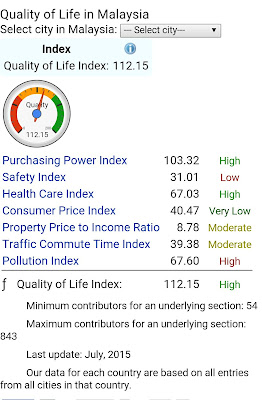


Are there any comparative indexes for comparison of living standard or quality of life (QoL) and property price ratio to income?
A.
www.numbeo.com is an interesting portal for indices which can be used for city to city comparison. It provides figures on 'Cost of Living' and this includes some common economics indexes like CPI, Food Prices, Property Prices, Rental Value, Transportation Cost, etc.
The good thing is that different currency can be chosen for comparison. For my comparison below, I chose to use MYR Ringgit as the common currency for comparison.
Of course, any figure would be subject to bias. This method is gathering figures from public probably without much filter, and therefore, the data collected only reflects certain accuracy level likely to take as face value. Nevertheless, it is quite a good source of data if the contributors are in hundreds and thousands.
Some comparisons are inserted below for your reading.


The analysis above showed among others:
1. The property price to income ratio being accurately indicating the most expensive property in Hong Kong.
2. Pollution index is probably quite accurate too with some cities being norturiously polluted.
3. The criticism is likely the fact that some figure are relative to each other and not absolute. For example, property price to Income ratio is subjected to two parameters. One being the property price, and another being the income. Hence, the same property price with different income level would arrive at two different scenarios. For within Malaysia, there are cities will higher income like KL, and less income like Kuching.
Hence, if the income difference level is big, the property prices may differ a lot although the ratio is the same. Take for example, 100:10 vs 300:30, they are of the same ratio, but the property price is three times more!
Well, to make it look more realistic. Let's see 3,000,000:300,000 (KUL) and 1,000,000:100,000 (KCH). Most people can probably earn 100,000 a year. In KUL most likely 300,000 a year is also not alarmingly high. But 1 mio vs 3 mio property, that is a big gap! Imagine the 3 mio property in Kuching, that is astronomical!
picture below shows the various items taken in pricing survey as bases of comparison.

Ref:
Sunday, July 12, 2015
Part II : Comparative index on property appreciation
Q.
I have read your Part I on IPI - Inter-Property-Index, but it is about how good one property is able to generate return in rental versus another similar property. How about growth in its own value, or capital gain?
A.
To a investor, there are generally two major parameters of property appraisal. One is on the return of use (rental return) and the other return upon transfer of ownership (capital gain). The terminology used here is generic, as I have not fully completed the subject on 'Property Valuation'.
The IPI method is rental return per unit of investment on a property at a designated location. So, similar properties with 2.0/05.15/KUL in the same area should generate similar yield. However, they may be slightly different in capital appreciation.
Take for example, a double storey landed property would have different appreciation value if compared to a town house, or a condominium. Some locality with demand for matured population would prefer landed property. On the other hand, an old Taman may have demand for modern looking condo despite abundance of double storey old houses nearby.
Why?
Because of nearby amenities, like hospital, schools or colleges, shopping complexes, offices or tourist attractions.
Take for instance, houses nearby a referral hospital can be used for rental. Demand for room rental or home stay by hospital staff is a common occurrence. Similarly, when there is college or university in the vicinity, the demand for rental is high. All these factors induce better IPI. However, imagine if you are a junior doctor who has no time to take care of an old house, you would prefer an apartment over say, an old bungalow. If your were a college student, you would opt for a condo anytime because of security and easy maintenance. Parents would ensure security by even spot-checking on these properties as they can't trust their kids living independently in a far away land.
Therefore, some properties will have higher demand for long term rental return. In fact, in countries like Korea and Taiwan, town buildings like shoplots are converted to apartments for rental to office workers. Due to consistent demand, these buildings will generate return on yield in subsequent transfers. Of course, from face value, the return on rental (IPI) is obviously better too, immediately outfront.
This new Index is called "TRIPI" or "Transfer Return - Inter Property Index".
A sale of property with IPI of 2.0|05.15|KUL at 100% appreciation over 5 years would be written as : 100/5|2.0|05.15|KUL. This property is like a condo which was RM280k five years ago, and now has appreciated to RM560k.
A similar price property of double storey landed house would have fetched RM350k five years ago, so the TRIPI for this property is 560/350 = 60%; ie 60/5|2.0|05.15|KUL.
Comparing these two properties, it would be more profitable to invest in the condo rather than the double storey landed house. Of course, the return of rental (2.0) did not make any immediate difference. However, the value for sale is much higher.
These numbers would indicate that such properties have appreciation value at equivalent Rental Return Value.
By collecting these data throughout the region, investors will have a grap of how much risk and return in putting their money on a property.
Of course, certain factors would still make the indexes vulnerable to risks, for example general economic trends, saturation point (e.g. the condo appreciated to 560K and the upside is limited), loan availability, new competitors and government regulations. Nevertheless, the Indexes would give a comparative picture of property prices with less influence of psychological sentiments or hypes by the gimmicks played by media or property agents and developers.
Summary
In the myriad of properties, how can an investor make a judgmental decision? This is the aim of this article and the earlier one on IPI here.
It is my hope that with IPI and TRIPI, decision tree of property investment can be made simpler and more objective. The mind could focus on common factors to consider and thereafter compare and contrast. If it is less influenced by emotions, the decision arrived hopefully can be less speculative and bias. Therefore, paving a direction towards a more transparent property market where investor can make informed decisions.
Ref:
Own account.
12.Jul.2015.
I have read your Part I on IPI - Inter-Property-Index, but it is about how good one property is able to generate return in rental versus another similar property. How about growth in its own value, or capital gain?
A.
To a investor, there are generally two major parameters of property appraisal. One is on the return of use (rental return) and the other return upon transfer of ownership (capital gain). The terminology used here is generic, as I have not fully completed the subject on 'Property Valuation'.
The IPI method is rental return per unit of investment on a property at a designated location. So, similar properties with 2.0/05.15/KUL in the same area should generate similar yield. However, they may be slightly different in capital appreciation.
Take for example, a double storey landed property would have different appreciation value if compared to a town house, or a condominium. Some locality with demand for matured population would prefer landed property. On the other hand, an old Taman may have demand for modern looking condo despite abundance of double storey old houses nearby.
Why?
Because of nearby amenities, like hospital, schools or colleges, shopping complexes, offices or tourist attractions.
Take for instance, houses nearby a referral hospital can be used for rental. Demand for room rental or home stay by hospital staff is a common occurrence. Similarly, when there is college or university in the vicinity, the demand for rental is high. All these factors induce better IPI. However, imagine if you are a junior doctor who has no time to take care of an old house, you would prefer an apartment over say, an old bungalow. If your were a college student, you would opt for a condo anytime because of security and easy maintenance. Parents would ensure security by even spot-checking on these properties as they can't trust their kids living independently in a far away land.
Therefore, some properties will have higher demand for long term rental return. In fact, in countries like Korea and Taiwan, town buildings like shoplots are converted to apartments for rental to office workers. Due to consistent demand, these buildings will generate return on yield in subsequent transfers. Of course, from face value, the return on rental (IPI) is obviously better too, immediately outfront.
This new Index is called "TRIPI" or "Transfer Return - Inter Property Index".
A sale of property with IPI of 2.0|05.15|KUL at 100% appreciation over 5 years would be written as : 100/5|2.0|05.15|KUL. This property is like a condo which was RM280k five years ago, and now has appreciated to RM560k.
A similar price property of double storey landed house would have fetched RM350k five years ago, so the TRIPI for this property is 560/350 = 60%; ie 60/5|2.0|05.15|KUL.
Comparing these two properties, it would be more profitable to invest in the condo rather than the double storey landed house. Of course, the return of rental (2.0) did not make any immediate difference. However, the value for sale is much higher.
These numbers would indicate that such properties have appreciation value at equivalent Rental Return Value.
By collecting these data throughout the region, investors will have a grap of how much risk and return in putting their money on a property.
Of course, certain factors would still make the indexes vulnerable to risks, for example general economic trends, saturation point (e.g. the condo appreciated to 560K and the upside is limited), loan availability, new competitors and government regulations. Nevertheless, the Indexes would give a comparative picture of property prices with less influence of psychological sentiments or hypes by the gimmicks played by media or property agents and developers.
Summary
In the myriad of properties, how can an investor make a judgmental decision? This is the aim of this article and the earlier one on IPI here.
It is my hope that with IPI and TRIPI, decision tree of property investment can be made simpler and more objective. The mind could focus on common factors to consider and thereafter compare and contrast. If it is less influenced by emotions, the decision arrived hopefully can be less speculative and bias. Therefore, paving a direction towards a more transparent property market where investor can make informed decisions.
Ref:
Own account.
12.Jul.2015.
Wednesday, May 20, 2015
Part I : IPI - Inter-Property Index
Q.
I have different properties in different places. They generate different returns for me. How can I compare and contrast among them?
A.
24.06.2015 - Part II : Comparative index on property appreciation here.
No two properties are the same. This is a famous phrase by the property guru.
Why?
Because it is like two persons, they can never be entirely the same. Take for example, a house facing North is already different from his opposite neighbour who is facing South. Especially to some mystic belief of Feng Shui or tradition, some people would only settle with facing South, no matter how similar are the two unit of houses.
Even on the same facing, like two similar size of apartment facing the same direction, the block which has a better number or floor would be easier to sell.
Such ridiculous comparison can become even more out of proportion when some repair and maintenance had been carried out to the said properties.
Hence, the issue is no comparison is entirely fair in the right mind of the dynamically changing property market, so why is there an "Inter-Property Index"?
Objective: An index simple to use for inter comparison of property for easy investment decision.
Applicability: Investment appraisal and suitability for various property types through modifications.
It is difficult to cover every angle of a property as common bases are generally aimed at values which are objective and absolute, rather than suggestive, subjective and qualitative.
Thus, the common bases are like:
New or old is not considered in the index because the above Index is for secondary market - Secondary IPI. Modification can be done with Base No.6 taken out to be new properties - Primary IPI. This base can be replaced with attribute like 'Facing, direction' where the choice of units facing a better view fetch higher value than, say the units facing cemetery.
So, various bases are allocated points to reflect the high and low of the base chosen. Each attribute would be given a point, so as to reflect the scores per base. All the bases are aggregated together to have a total score.
That being the total score, it is multiplied by the local rental return factor (annual rental yield). This rental return factor is taken as an average of the rental return per year for similar type of unit in the same area. For example, the rental of a unit of apartment which costs 400k is 1,500 per month - 18k annually.
Maximum IPI = 60 x 18/400 = 2.7.
A similar property which costs 300k would be 60 x 18/300 = 3.6
And, a poor state of the same property which is smaller unit of the same block would have a score, say 45. The IPI would be:
45 x 18/400 = 2.0.
Hence, this is a predictive index to investment appraisal so that the best money is put into the best property. Of course, another two important information are time and locality, which segmentize the selection of properties. I would suggest the index be written as:
Total Score | Time in month/year | key Region, for example -
2.0 | 05/15 | KUL
I hope to design a good mix of properties to be able to produce a yearly index list.
I welcome your feedback on how to develop this Index for our future use. Feel free to email me or comment on this page as your opinion and criticism is important to me.
Proceed to Part II on TRIPI.
Ref:
Own account
I have different properties in different places. They generate different returns for me. How can I compare and contrast among them?
A.
24.06.2015 - Part II : Comparative index on property appreciation here.
No two properties are the same. This is a famous phrase by the property guru.
Why?
Because it is like two persons, they can never be entirely the same. Take for example, a house facing North is already different from his opposite neighbour who is facing South. Especially to some mystic belief of Feng Shui or tradition, some people would only settle with facing South, no matter how similar are the two unit of houses.
Even on the same facing, like two similar size of apartment facing the same direction, the block which has a better number or floor would be easier to sell.
Such ridiculous comparison can become even more out of proportion when some repair and maintenance had been carried out to the said properties.
Hence, the issue is no comparison is entirely fair in the right mind of the dynamically changing property market, so why is there an "Inter-Property Index"?
Objective: An index simple to use for inter comparison of property for easy investment decision.
Applicability: Investment appraisal and suitability for various property types through modifications.
It is difficult to cover every angle of a property as common bases are generally aimed at values which are objective and absolute, rather than suggestive, subjective and qualitative.
Thus, the common bases are like:
- Price range; the higher the price the lower the score.
- Size; the bigger the size the bigger the score.
- Type of property; high for landed property, low on flats and shop apartments.
- Connectivity; high for easy connectivity, low for poor accessibility from main road or city.
- Parking; high on 2 parking lots and sheltered, low on no parking.
- Renovation; high on extension and build in cabinet, low on no renovation or run down.
So, various bases are allocated points to reflect the high and low of the base chosen. Each attribute would be given a point, so as to reflect the scores per base. All the bases are aggregated together to have a total score.
That being the total score, it is multiplied by the local rental return factor (annual rental yield). This rental return factor is taken as an average of the rental return per year for similar type of unit in the same area. For example, the rental of a unit of apartment which costs 400k is 1,500 per month - 18k annually.
Maximum IPI = 60 x 18/400 = 2.7.
A similar property which costs 300k would be 60 x 18/300 = 3.6
And, a poor state of the same property which is smaller unit of the same block would have a score, say 45. The IPI would be:
45 x 18/400 = 2.0.
Hence, this is a predictive index to investment appraisal so that the best money is put into the best property. Of course, another two important information are time and locality, which segmentize the selection of properties. I would suggest the index be written as:
Total Score | Time in month/year | key Region, for example -
2.0 | 05/15 | KUL
I hope to design a good mix of properties to be able to produce a yearly index list.
I welcome your feedback on how to develop this Index for our future use. Feel free to email me or comment on this page as your opinion and criticism is important to me.
Proceed to Part II on TRIPI.
Ref:
Own account
Subscribe to:
Posts (Atom)